

Concrete Foundation Blocks: Types, Sizes & Best Uses
Concrete foundation blocks are one of the most common building materials used to support homes, garages, retaining walls, and commercial buildings. Also called concrete masonry units, or CMUs, these pre-cast blocks are stacked in courses and bonded with mortar to create strong, load-bearing walls. If you own a home with a block foundation, or you are planning a new structure and weighing your options, understanding how these blocks work will help you make smarter decisions. Many homeowners also ask about the best concrete for foundation repair when problems show up later, and that answer always starts with knowing what your foundation is made of in the first place.
In this guide, we explain what concrete foundation blocks are, the different types and sizes available, how they compare to poured concrete, and the common problems block foundations face in the Greater Houston area.
What Are Concrete Foundation Blocks?
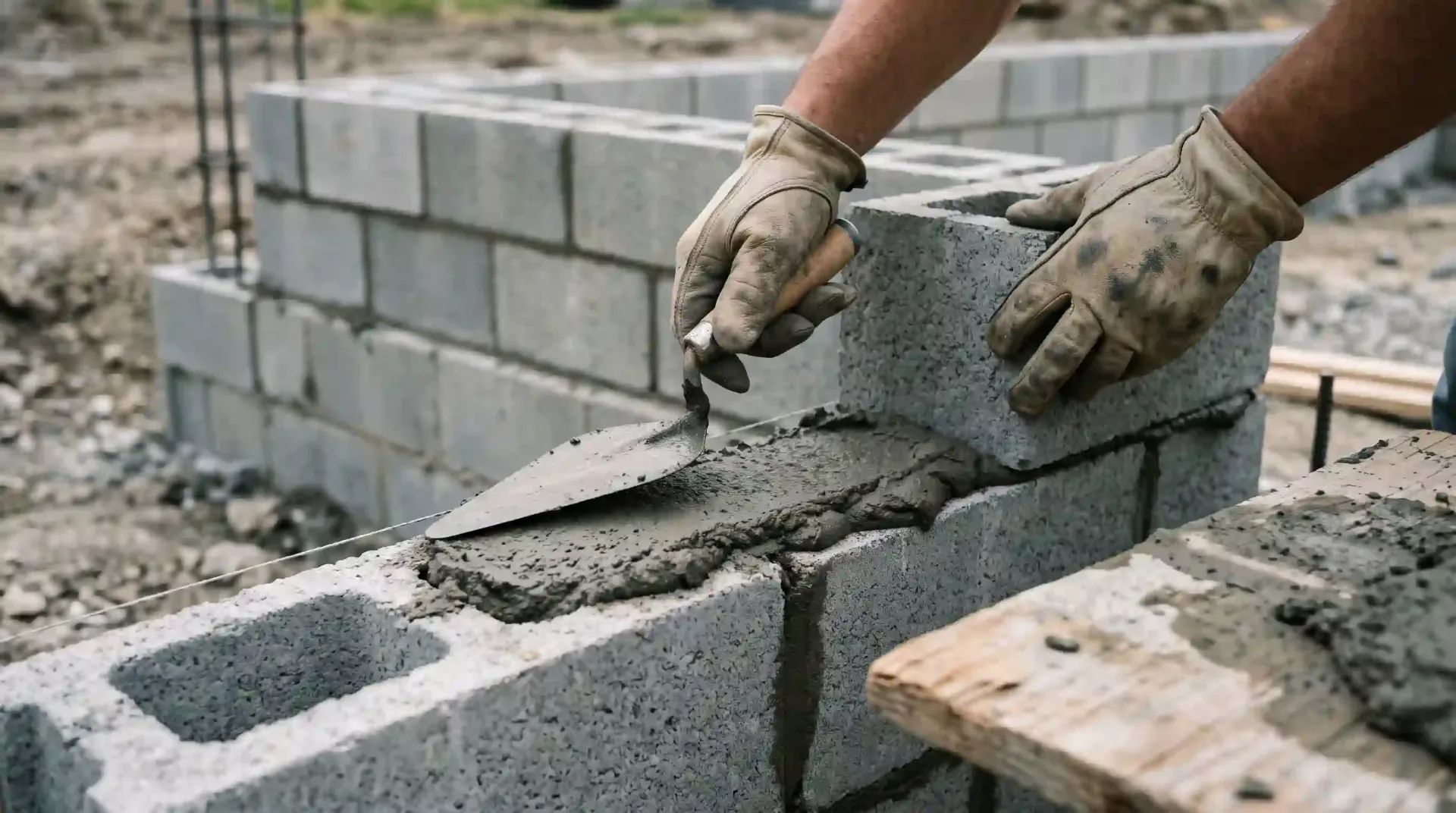
Concrete foundation blocks are rectangular units manufactured from Portland cement, water, and aggregates such as sand, gravel, or crushed stone. Most blocks are produced with hollow cores. The cores reduce weight, improve insulation, and allow builders to run steel rebar and grout through the openings for added strength. Solid blocks are also available for areas that need extra bearing capacity.
Blocks are laid on a poured concrete footing, which spreads the weight of the structure across the soil below. Each row of blocks, called a course, is offset from the one beneath it so vertical joints do not line up. This running bond pattern ties the wall together and resists cracking. When the hollow cores are filled with grout and reinforced with rebar, a block wall can carry loads comparable to a poured concrete wall.
Block foundations are especially common in crawl space homes, basement walls, stem walls, garages, and outbuildings. Because the blocks are modular, they are easy to transport, quick to stack, and fit almost any footprint.
Common Types of Concrete Foundation Blocks
Builders choose blocks based on where they sit in the wall and what load they need to carry.
Stretcher Blocks
The stretcher is the standard workhorse block used for the main body of a wall. It has two or three hollow cores and flanged ends that lock into the mortar joint.
Corner Blocks
Corner blocks have one flat, finished end so the corner of a wall looks clean and square. They are used wherever a wall ends or turns.
Solid Blocks
Solid concrete blocks have no cores. They are heavier and denser, which makes them ideal for the bottom courses of a foundation, load-bearing piers, and areas exposed to heavy moisture.
Bond Beam and Lintel Blocks
Bond beam blocks have a U-shaped channel that holds horizontal rebar and grout, creating a continuous reinforced beam across the top of a wall. Lintel blocks serve a similar purpose above windows, doors, and vents.
Jamb and Sash Blocks
These blocks have a groove or notch that accepts window and door frames, giving the opening a tight, finished fit.
Split-Face and Decorative Blocks
Split-face blocks have a rough, stone-like texture on one side. They are often used on exposed foundation walls, retaining walls, and commercial exteriors where appearance matters.
Standard Sizes and Dimensions
In the United States, the most common concrete foundation block measures 8 inches wide, 8 inches high, and 16 inches long. These are nominal dimensions. The actual block is about 7 5/8 by 7 5/8 by 15 5/8 inches, with the missing 3/8 inch accounted for by the mortar joint. Other widths are widely available:
- 4-inch blocks for partition walls and veneers
- 6-inch blocks for light-duty walls and garden structures
- 8-inch blocks for most residential foundations
- 10-inch and 12-inch blocks for basement walls, retaining walls, and commercial foundations that face heavy soil pressure
Half blocks, which are 8 inches long, are used to maintain the running bond pattern at corners and openings. A standard 8x8x16 hollow block weighs around 35 to 38 pounds, while a solid block of the same size can weigh 50 pounds or more.
How Strong Are Concrete Foundation Blocks?
Strength is one of the main reasons concrete foundation blocks remain popular. Load-bearing blocks in the U.S. are manufactured to ASTM C90 standards, which require a minimum net compressive strength of about 2,000 psi.
The real strength of a block foundation, however, comes from the system as a whole. Three things make the biggest difference:
- Footing quality. A level, properly sized footing keeps the wall from settling unevenly.
- Reinforcement. Vertical rebar placed in the cores and horizontal rebar in bond beams tie the wall together and resist bending.
- Grout fill. Filling the cores with grout turns a hollow wall into a solid, monolithic mass that resists lateral soil pressure.
A block wall that is unreinforced and ungrouted is strong in compression but weak against sideways forces. That weakness becomes important in regions with expansive clay soil, where the ground pushes against foundation walls as it swells with moisture.

Pros and Cons of Concrete Block Foundations
Advantages
- Cost-effective. Blocks are inexpensive to produce and require less formwork than poured concrete.
- Fast to build. Experienced masons can lay several courses a day without waiting for large concrete pours to cure.
- Flexible design. Modular units work well for curved walls, stepped footings, and irregular lots.
- Fire and pest resistant. Concrete does not burn, rot, or attract termites.
- Easy to repair in sections. Individual blocks or mortar joints can be replaced without disturbing the entire wall.
Disadvantages
- Mortar joints are weak points. Every joint is a potential path for water and a potential crack line.
- Lower resistance to lateral pressure when unreinforced. Walls can bow or lean under soil pressure.
- More porous than poured concrete. Blocks absorb moisture unless they are sealed and waterproofed.
- Labor sensitive. The quality of the wall depends heavily on the skill of the mason.
Concrete Block vs. Poured Concrete Foundations
Both are reliable when built correctly, but they behave differently over time.
Poured concrete foundations are formed on site as a single continuous wall. They have no joints, so they resist water intrusion and lateral pressure better. They also offer higher compressive strength per square inch. The trade-off is higher cost, more site preparation, and longer cure times.
Concrete foundation blocks cost less, go up faster, and are easier to modify. With proper reinforcement, grout, and waterproofing, a block foundation can match the performance of poured concrete for most residential applications. Without those steps, it is more vulnerable to moisture and movement.
In the Houston area, where slab-on-grade construction dominates, block foundations are more common in older homes, pier and beam stem walls, garages, retaining walls, and commercial structures.
Common Problems With Block Foundations in Houston
Houston sits on expansive clay soil that swells during wet months and shrinks during summer drought. This constant movement puts stress on every foundation type, but block foundations show the strain in specific ways.
- Stair-step cracks. Cracks that follow the mortar joints in a staircase pattern usually indicate differential settlement, where one part of the footing sinks faster than another.
- Horizontal cracks and bowing. When saturated clay pushes against a basement or stem wall, the wall can crack horizontally along a mortar joint and begin to bow inward. This is a serious structural warning sign.
- Water seepage. Because blocks are porous and mortar joints are permeable, water often finds its way through the wall after heavy rain. Efflorescence, the white powdery residue on block surfaces, is a sign that moisture is moving through the masonry.
- Deteriorating mortar. Over decades, mortar can crumble or wash out, leaving blocks loose and the wall weaker.
- Spalling. Repeated moisture exposure can cause the face of a block to flake or chip away.
If you notice any of these symptoms, a professional cracked and leaking foundation repair inspection can determine whether the problem is cosmetic or structural. Early repairs, such as crack injection, wall anchors, carbon fiber straps, or re-pointing mortar joints, are far less expensive than rebuilding a failed wall.
How Much Do Concrete Foundation Blocks Cost?
Material prices vary by region and block type, but a standard 8x8x16 hollow block generally costs between $2 and $5 per unit. Solid, split-face, and specialty blocks cost more. Installed, a block foundation wall typically runs $10 to $25 per square foot, depending on wall height, reinforcement, grout fill, waterproofing, and local labor rates.
For comparison, a poured concrete wall often costs 15 to 30 percent more installed. Repairing an existing block foundation is usually far cheaper than replacing it, which is why addressing small cracks and drainage issues early pays off.
Tips for Protecting a Concrete Block Foundation
A little maintenance goes a long way:
- Keep water away from the wall. Extend downspouts at least five feet from the foundation and make sure the soil slopes away from the house.
- Seal and waterproof exposed block. A quality masonry sealer or exterior waterproofing membrane reduces moisture absorption.
- Watch for new cracks. Mark the ends of any crack with a pencil and date it. If it grows, call a professional.
- Maintain consistent soil moisture. In Houston's clay, a foundation watering system during dry months prevents the soil from pulling away from the footing.
- Control tree roots. Large trees within 20 feet of the foundation can draw moisture from the soil and cause settlement.
Homeowners searching for dependable
foundation repair in Houston, TX should look for a contractor who understands local soil conditions, provides a written assessment, and backs the work with a transferable warranty.

Final Thoughts
Concrete foundation blocks offer an affordable, durable, and adaptable way to build foundations, stem walls, and retaining walls. Their performance depends on proper footing design, reinforcement, grout fill, and waterproofing.
If your block foundation is showing cracks, bowing, or water intrusion, do not wait for the damage to spread. Two Brothers Foundation Repair has served Houston homeowners for over 20 years with free inspections, honest recommendations, and a lifetime transferable warranty on every repair. Contact us today to schedule your free foundation assessment.
Frequently Asked Questions
What are concrete foundation blocks made of?
Concrete foundation blocks are made from Portland cement, water, and aggregates such as sand, gravel, or crushed stone. Lightweight versions use expanded shale, clay, or slag to reduce weight while keeping structural strength.
How long do concrete block foundations last?
A properly built and maintained block foundation can last 80 to 100 years or more. Longevity depends on footing quality, reinforcement, drainage, and how well the wall is protected from moisture.
Are hollow or solid concrete blocks better for foundations?
Hollow blocks are the standard choice because they are lighter, cheaper, and can be reinforced with rebar and grout. Solid blocks are better for the bottom courses, piers, and areas that carry concentrated loads or face constant moisture.
Can concrete foundation blocks handle Houston's clay soil?
Yes, but only with proper reinforcement, grout fill, drainage, and footing design. Unreinforced block walls are prone to bowing and cracking when expansive clay swells against them.
How do I know if my block foundation needs repair?
Look for stair-step cracks along mortar joints, horizontal cracks, walls that bow inward, water seepage, white efflorescence stains, or crumbling mortar. Any of these signs warrants a professional inspection.
Is a block foundation cheaper than poured concrete?
Generally, yes. Block foundations cost less in materials and labor and go up faster. Poured concrete typically costs 15 to 30 percent more but offers better resistance to water and lateral pressure.