

Let Two Brothers Protect Your Foundation and Your Trees
Root Barrier Installation in Houston, Texas
☼
Keep the Tree. Protect the Foundation.
A mature live oak is one of the best things about a Houston property and one of the most demanding things sitting next to your slab. It draws an enormous volume of moisture out of the clay, and it does it from one side of the house.
That is uneven drying, which produces uneven movement, which is the most damaging kind. A root barrier addresses it without asking you to choose between the tree and the house.
Large tree close to the house, or cracks appearing on the tree side? Call 832-710-6957 for a free assessment.
Root barriers pair naturally with foundation watering systems. One reduces how much moisture leaves the soil, the other replaces what does.
Why Houston Homeowners Call Two Brothers
- 20+ years watching Houston clay move under real houses
- A+ BBB accredited and fully insured
- Tree-preserving approach, because removal often makes things worse
- Free written assessment, no obligation and no pressure
- Licensed structural engineers on the projects that need them
- Honest limits, including when a barrier will not help you
Prefer to write? Use the contact form and we will call you back.
Trees Do Not Push Foundations. They Drink.
The common picture is a root growing under a slab and levering it upward. That happens to sidewalks and driveways, which are thin and sit on shallow ground. It is rarely what a tree does to a house foundation.
The real mechanism is moisture. A mature tree moves a very large amount of water out of the soil every day through its roots, and its root zone commonly extends well beyond the spread of its canopy. In Houston's clay, soil that has had its moisture drawn out shrinks.
So the tree quietly dries out the ground on one side of your house, that side shrinks, and your slab loses support unevenly. The far side of the house, with no tree near it, does not move the same way.
Differential movement is what cracks foundations. Uniform settlement across a whole house is far less damaging than one corner dropping while the rest stays put, and a large tree on one elevation is a reliable way to produce exactly that.
Signs a Tree Is Affecting Your Foundation
The pattern matters more than any single symptom. Tree-driven movement is one-sided, and that is what identifies it.
Cracks Concentrated on the Tree Side
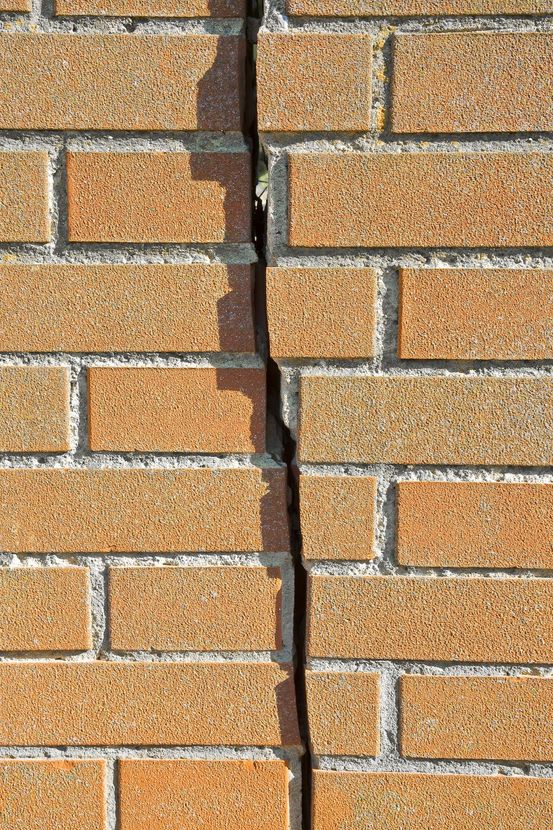
Damage clustered on one elevation, the one nearest a mature tree, while the opposite side of the house is fine. That asymmetry is the signature.
Cracked foundation repair ›A Large Tree Close to the Structure
Roots commonly extend well past the canopy edge, so a tree does not need to be touching the house to be reaching under it. Species matters too, since some are far thirstier than others.
Free structural assessment ›Soil Pulling Away on One Elevation
A gap between the ground and the slab that appears on the tree side and not elsewhere. Direct evidence of where the moisture is being removed.
Foundation watering systems ›Damage That Worsens Every Dry Summer
A tree competes hardest for water when there is least of it. Movement that accelerates through drought and eases after sustained rain points at moisture extraction rather than a structural fault.
Residential foundation repair ›Lifted Flatwork Near the Tree
Sidewalks, driveways, and patios do get physically lifted by roots, because they are thin and sit shallow. This is the visible version of what is happening less obviously deeper down.
Sidewalk repair ›You Are Planning to Plant or Build
The cheapest time to install a barrier is before there is a problem. Adding a tree near the house, or extending toward an existing one, is the moment to think about it.
All our services ›Recognize this pattern? An assessment tells you whether the tree is actually the cause.
Call 832-710-6957Root Barrier, Removal, Pruning, or Nothing?
Four ways to respond to a tree that is affecting your foundation, and they are not equally good.
| Factor | Root Barrier | Tree Removal | Root Pruning Alone | Do Nothing |
|---|---|---|---|---|
| Keeps the tree | Yes | No | Yes, but stressed | Yes |
| Stops moisture extraction near the slab | Yes, going forward | Yes, abruptly | Temporarily, roots regrow | No |
| Risk of heave afterward | Low, change is gradual | Real, soil rehydrates and swells | Low | None, but drying continues |
| Effect on tree stability | Minimal if properly placed | Tree gone | Can destabilize if roots cut too close | None |
| Property value impact | Tree retained | Mature tree lost | Tree retained | Tree retained, damage continues |
| Ordinance considerations | Usually straightforward | Some trees are protected | May require consultation | None |
| Relative cost | Middle | High, plus stump and disposal | Low, but repeats | Nothing now, more later |
Removal looks decisive and is frequently the worst option available. The reason is in the next section.
Our Root Barrier Installation Process
Free On-Site Assessment
We take elevation readings across the house, look at where damage is concentrated, identify the trees and their likely root spread, and check soil condition on each elevation. Written proposal, no obligation.
Confirming the Tree Is Actually the Cause
Plenty of Houston foundations move for reasons that have nothing to do with trees. If the movement pattern does not match the tree position, a barrier will not help and we will say so.
Planning Placement and Depth
The barrier is positioned between the tree and the structure, deep enough to intercept the roots doing the moisture extraction, and routed to avoid destabilizing the tree or cutting through utilities.
Checking Tree Protections and Utilities
Some trees carry local protections, and consultation may be required before work near them. Utilities are located before any trenching. We confirm what applies before quoting.
Trenching and Barrier Installation
A trench is excavated along the planned line, the barrier material is installed vertically to redirect roots downward and away, and the trench is backfilled and the surface restored.
Moisture Management and Follow-Up
A barrier stops further extraction. Restoring the moisture already lost usually means watering as well. See foundation watering systems and our process.
Why Removing the Tree Often Makes It Worse
This is the most valuable thing on this page, and it runs against every instinct a worried homeowner has.
The reasoning seems airtight: the tree is drying the soil, so remove the tree and the drying stops. The first half is right. The problem is what happens next.
That tree has been extracting moisture from the clay for decades, and the soil under that side of your house has reached an equilibrium at a lower moisture content. Take the tree away and nothing is drawing the water out any more, so the clay rehydrates and swells.
Soil that has been dry for twenty years does not return to its old level gently. It heaves, and it heaves under a section of foundation that had settled to match the drier condition. Homes that were stable with a large tree beside them have been damaged by its removal, sometimes badly, and often a year or more afterward when nobody connects the two events.
Which is why removal is the option we raise last rather than first. A barrier changes the moisture situation gradually and predictably. Removal changes it abruptly and in the direction nobody planned for.
There are cases where a tree genuinely has to go: disease, storm damage, or a real safety risk. If yours is one of them, that is an arborist's call, and we would want the foundation monitored afterward.

What a Root Barrier Will Not Do
Root barriers work, and they are oversold often enough that the limits are worth stating plainly before you buy one.
A barrier works forward, not backward. It stops roots crossing the line from the day it goes in. It does not undo years of accumulated drying, and it will not lift a foundation that has already settled on that side. Where damage exists, structural repair comes first and the barrier protects the result.
It does not help if the roots are already past it. If a root system has grown well beneath the slab, a barrier installed at the perimeter is closing a gate the roots came through years ago.
And it does nothing about the moisture already gone. Stopping extraction is half the job. Restoring soil moisture on that side usually means watering as well, which is why the two services are almost always discussed together.
If your movement pattern does not actually point at a tree, a barrier is money spent on the wrong problem. That is the first thing we check.
Five Myths About Trees and Foundations
Trees generate more bad foundation advice in Houston than anything except drainage.
Roots push foundations up
They do that to sidewalks and driveways, which are thin and shallow. Against a house foundation the dominant mechanism is moisture extraction, not physical force. The tree dries the clay on one side, the clay shrinks, and the slab loses support. Understanding this matters, because the fix for lifting and the fix for drying are different. Both happen: lifting to flatwork, drying to the house.
Cut the tree down and the problem is solved
Frequently the opposite. Soil that has been kept dry for decades rehydrates once the tree stops drawing on it, and expansive clay rehydrating means heave, under a section of foundation that had already settled to the drier condition. Damage often appears a year or more later, by which point nobody links it to the removal. If a tree must go for disease or safety, have the foundation monitored afterward.
The roots only reach as far as the branches
Root spread commonly extends well beyond the canopy edge, so a tree does not need to be near the wall to be reaching under the house. This is why homeowners are often surprised that a tree they considered a comfortable distance away is implicated at all. Practical implication: distance alone does not rule a tree out.
Just cut the roots on the house side
Root pruning on its own is temporary, because roots regrow toward the moisture. Worse, cutting substantial roots close to the trunk can destabilize a mature tree, which matters in a city that gets hurricanes. Pruning as part of a barrier installation is normal. Pruning as the entire strategy is not. Ask before anyone cuts: what does this do to the tree's stability?
A barrier fixes the damage I already have
It prevents further extraction from that day forward. It does not lift a settled foundation, close existing cracks, or restore the moisture already drawn out. Where damage exists, repair comes first, then the barrier protects the repair, and watering restores the moisture balance. Correct order: assess, repair if needed, barrier, then watering.
When a Root Barrier Is and Is Not the Answer
Being straight about where this service earns its money.
| Situation | Barrier Suitable? | Why |
|---|---|---|
| Mature tree near the house, no damage yet | Strong fit | Prevention is cheapest and works best before drying accumulates |
| Damage concentrated on the tree elevation | Strong fit | Pattern matches the cause, barrier stops it worsening |
| Planting a new tree near the house | Strong fit | Installed before roots establish, entirely straightforward |
| Roots already established under the slab | Limited | The barrier closes a route the roots already used |
| Foundation already settled significantly | Supporting role | Repair first, barrier protects the result afterward |
| Damage on the elevation with no trees | No | Something other than a tree is causing it |
| Uniform movement all around the house | No | Points to drainage or wider soil conditions, not a tree |
| Lifted sidewalk only, house unaffected | Usually no | That is a flatwork repair, not a foundation issue |
If your situation sits in the bottom rows, we will point you at the service that actually addresses it.
What Affects Root Barrier Cost in Houston
Barriers are priced largely by the length of trench, which makes the estimate fairly predictable once the layout is set.
The main driver is how much barrier length the property needs and how difficult the ground is to trench. A clear run along an open side yard is straightforward. A route crossing utilities, irrigation, hardscaping, or heavy root mass takes considerably longer.
- Length of barrier required
- Depth needed to intercept the relevant roots
- Barrier material specified
- Soil conditions and existing root density along the line
- Utilities, irrigation, and services to work around
- Hardscaping that must be crossed or removed and reinstated
- Access for trenching equipment
- Any tree protection consultation required
- Surface restoration and landscaping reinstatement
Worth budgeting alongside it: watering, since a barrier stops further moisture loss but does not replace what has already gone. The two together are the complete answer.
Every assessment and written estimate is free. If financing would help, we offer payment plans.
Six Questions to Ask Before You Install One
A barrier in the wrong place is money in a trench. These questions establish whether the diagnosis holds up.
How do you know the tree is causing this?
The answer should reference the pattern of movement across the house, not just the presence of a tree. If damage is spread evenly all round, a tree is not the explanation.
Did you take elevation readings across the whole house?
That is what establishes whether movement is one-sided. Without it, nobody can say the tree elevation is the one that dropped.
How deep will the barrier go, and why that depth?
Too shallow and roots simply travel under it. The depth should be reasoned from the tree, the soil, and where the roots are actually working, not a default number.
Will this destabilize the tree?
Cutting substantial roots on one side of a mature tree affects how well it stands up. Placement should account for that, particularly on the windward side in a hurricane region.
Are the roots already under my slab?
If they are, a perimeter barrier has limited value. An honest contractor will tell you when that is the case rather than trenching anyway.
What restores the moisture that has already gone?
The barrier stops further loss. It does not replace what was taken. If watering is not part of the conversation, only half the problem is being addressed.
We are happy to answer all six on the phone before you book anything.
Call 832-710-6957For HOAs, Property Managers, and Builders
On managed property, mature trees are usually an asset the community values and a foundation risk nobody has quantified. Removing them is unpopular, expensive, and as covered above, sometimes actively harmful.
Root barriers let a property keep its tree canopy while limiting the structural exposure, which is a considerably easier proposition to take to a board than a removal program.
For builders, installing barriers during construction near retained trees is far cheaper than retrofitting after a homeowner reports cracks, and it is a genuine differentiator on a lot with mature planting.
Call 832-710-6957 to Discuss a Property
Residential and Commercial Root Barrier Installation
Wherever mature trees stand near structures on Houston clay. We handle both property types.
Residential
Homes in Houston's older tree-lined neighborhoods, where mature oaks and the houses beside them have coexisted for decades. See our residential foundation repair services.
Commercial
Apartment complexes, offices, schools, and institutional properties with significant mature planting close to buildings. See our commercial foundation repair services.
Two Bros Foundation Repair Service Areas
Root barrier installation available across the Greater Houston area. Click any location to learn more about our foundation repair services in that area.
- Houston
- Sugar Land
- Katy
- Pearland
- League City
- Spring
- The Woodlands
- Conroe
- Cypress
- Tomball
- Humble
- Kingwood
- Friendswood
- Missouri City
- Pasadena
- Baytown
- Clear Lake
Tree protection rules vary between municipalities across the metro. We confirm what applies at your address.
View All Service AreasClient Testimonials: What Our Customers Are Saying
Good experience with Two Brothers Foundation repair! The team was very professional and very polite. They answered all my questions, and the working crew did a good job cleaning up the dirt that was dug out. I'd definitely recommend them to anyone asking for a good, reputable foundation repair company!
I had Two Brothers repair my home's foundation back in 2018, and it has had no problems since, now 7 years later. They were quick to answer even now as I look to sell the property and transfer the service. Would recommend to anyone who needs their foundation repaired.
Aaron & Jacob were very professional and walked me through the entire process. They made sure I was informed at each step and made sure they left the work area in an excellent condition when completed. Glad to be back on a level foundation again.
Related Foundation Services in Houston
A barrier stops moisture leaving. These deal with replacing it and repairing what has already moved.
Foundation Watering Systems
The other half of the answer. A barrier stops extraction, watering restores what was already taken.
Learn more ›Structural Foundation Assessments
Free elevation survey, which is what establishes whether movement is one-sided and tree-related.
Learn more ›House Leveling and Lifting
Where the tree side has already settled, piers restore elevation before the barrier protects it.
Learn more ›Sidewalk Repair
For the flatwork that roots have physically lifted, which is a different repair from the house.
Learn more ›Foundation Drainage Solutions
Where movement turns out to be about water arriving rather than a tree taking it away.
Learn more ›Cracked and Leaking Foundation Repair
For cracks that uneven drying has already opened in the slab.
Learn more ›Frequently Asked Questions (FAQs)
Still have questions about root barriers? See some of our frequently asked questions below or contact us today.
How do tree roots damage a foundation?
Mostly by drawing moisture out of the soil rather than by pushing. A mature tree moves a large volume of water out of the ground every day, and in Houston's expansive clay soil that loses moisture shrinks. Because the tree is on one side of the house, that side dries and shrinks while the far side does not, producing uneven movement. Physical root lifting does happen, but mainly to thin, shallow flatwork like sidewalks and driveways.
Should I just remove the tree?
Usually not, and it can make things worse. Soil kept dry by a tree for decades rehydrates once the tree is gone, and expansive clay taking on water swells. That means heave under a section of foundation that had already settled to match the drier condition. Damage frequently appears a year or more after removal, by which point nobody connects the two. Where a tree must go for disease or safety, that is an arborist's call, and the foundation should be monitored afterward.
What is a root barrier and how does it work?
A vertical barrier installed in a trench between the tree and the structure, deep enough to intercept the roots that are extracting moisture near the foundation. Rather than growing across toward the house, roots are redirected downward and away. The tree keeps living, and the soil beside your foundation stops being drained by it.
How deep does a root barrier need to be?
Deep enough to intercept the roots doing the work, which depends on the tree, the soil profile, and where the root activity actually is. Too shallow and roots simply travel underneath it. We determine depth during the assessment rather than applying one figure to every property.
Will a root barrier fix my existing foundation damage?
No. It works from the day it is installed forward, stopping further moisture extraction. It does not lift a foundation that has already settled, close existing cracks, or restore moisture already drawn out of the soil. Where damage exists, structural repair comes first, the barrier prevents recurrence, and watering restores the moisture balance.
How close does a tree have to be to cause problems?
Closer than most people expect, because root spread commonly extends well beyond the canopy edge. A tree that looks a comfortable distance from the house can still have roots working beneath it. Species matters too, since some trees are considerably thirstier than others. Distance alone does not rule a tree out.
Will installing a barrier hurt the tree?
Properly placed, the effect on a healthy mature tree is generally manageable, since the barrier redirects roots rather than removing the whole system. Placement matters though, because cutting substantial roots on one side affects stability, which is a real consideration in a hurricane region. That is why routing is planned rather than trenched wherever is convenient.
Do I need permission to install a root barrier?
It depends on the tree and the municipality. Some trees carry local protections, and work near them may require consultation before excavation. Rules vary across the Houston metro. We confirm what applies at your address as part of the assessment, and utilities are located before any trenching.
Do you offer free root barrier assessments?
Yes. We take elevation readings across the house, establish whether movement is actually one-sided and tree-related, identify the trees involved and likely root spread, and check what tree protection or utility considerations apply. If a tree is not the cause, you will hear that. Written proposal at no cost and no obligation. Call 832-710-6957.
Still have questions?
Still have questions about trees and your foundation? Give us a call or fill out the form on our contact page.
Contact us